- Select the estimating methods to be used.
- Set up a cost structure and identify cost categories.
- Produce a realistic cost summary.
2 hours CPD
A7.KCI-1: Estimate Project Costs
"Every project budget starts with an informed guess — the better your data and method, the better your estimate."
Estimating project costs is about:
- Identifying all resources and expenses needed to execute a project. This includes:
- direct costs (labour hours, materials, equipment, travel, training) and
- indirect costs (overheads, licences, opportunity costs).
A cost estimation process helps
- set realistic financial expectations,
- align with industry standards, and
- anticipate the total cost of ownership (TCO).
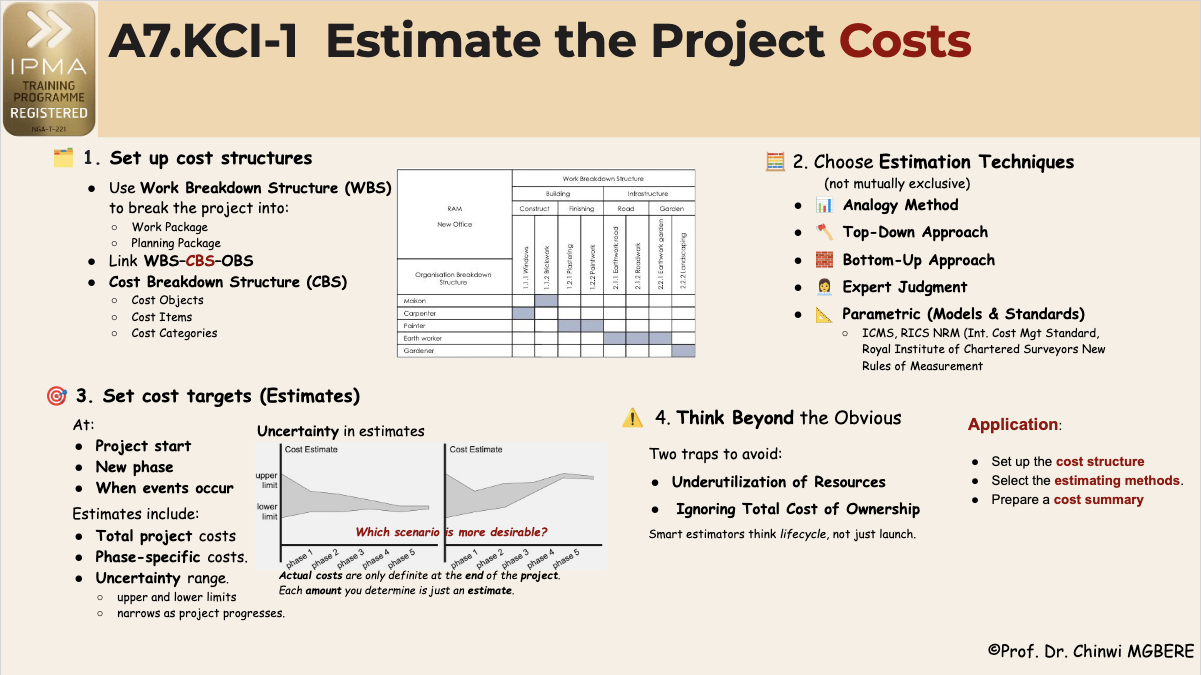
1. Set up cost structures and identify cost categories
Use the Work Breakdown Structure (WBS) to break the project into work packages or planning packages.
- Work Package: Fully defined deliverable with enough detail for accurate cost estimation.
- Planning Package: Broad activity with insufficient details at the current stage, estimated at a higher level.
Link CBS with WBS & OBS – The Cost Breakdown Structure (CBS) should align with the Work Breakdown Structure (WBS) and Organisation Breakdown Structure (OBS) so that costs are assigned to the right deliverables and responsible parties. (WBS–CBS–OBS)
Cost Breakdown Structure (CBS) – is a hierarchical framework for breaking down costs into:
- Cost Objects: What the cost is for (e.g., a deliverable, a system).
- Cost Items: Specific expenditures (e.g., labour, materials, subcontractor fees).
- Cost Categories: Resource types (e.g., manhours, materials, equipment, contractors).
2. Choose the appropriate Estimation Techniques
You can combine multiple methods for accuracy:
- Analogy Method – Uses cost data from similar projects to estimate the current one.
- Top-Down Approach – Breaks down the total project budget into smaller chunks for each major component.
- Bottom-Up Approach – Estimates each work package individually and sums them up to a total.
- Expert Judgment – Involves subject matter experts providing informed estimates.
- Parametric (Models & Standards) – Uses historical data and mathematical models to generate estimates.
3. Set cost targets using relevant standards, benchmarks, or internal guidelines.
Cost estimates should be updated at:
- Project start
- Beginning of each new phase
- When unexpected events occur
Estimates should include:
- Total project costs (costs incurred + forecasted costs).
- Phase-specific costs for the upcoming work.
- Uncertainty range (upper and lower limits), which narrows as the project progresses.
4. Think Beyond the Obvious
Two traps to avoid:
- Underutilization of Resources – Idle resources still cost money.
- Ignoring Total Cost of Ownership – A cheap choice today can be an expensive (operational cost) mistake tomorrow.
Smart estimators think lifecycle, not just launch.
To apply these actions to your current initiative, follow these steps:
- Set up the cost structure and identify all cost categories.
- Choose suitable estimating techniques based on available data and project stage.
- Prepare a cost summary that includes all categories, methods, and assumptions.
Now, Let’s Test Your Knowledge!