- Study the relevant phasing models.
- Choose the appropriate scheduling technique.
- Determine the appropriate phasing.
- Estimate the effects of uncertainty.
2 Hours (CPD)
A3.KCI-3. Determining the approach to the phasing
Choosing how to schedule and phase your project is a critical decision that shapes the project’s structure, delivery, and success. The chosen planning approach—whether waterfall, iterative, agile, or a hybrid—must be tailored to the project’s unique context: its goals, risks, organisational guidelines, and level of uncertainty
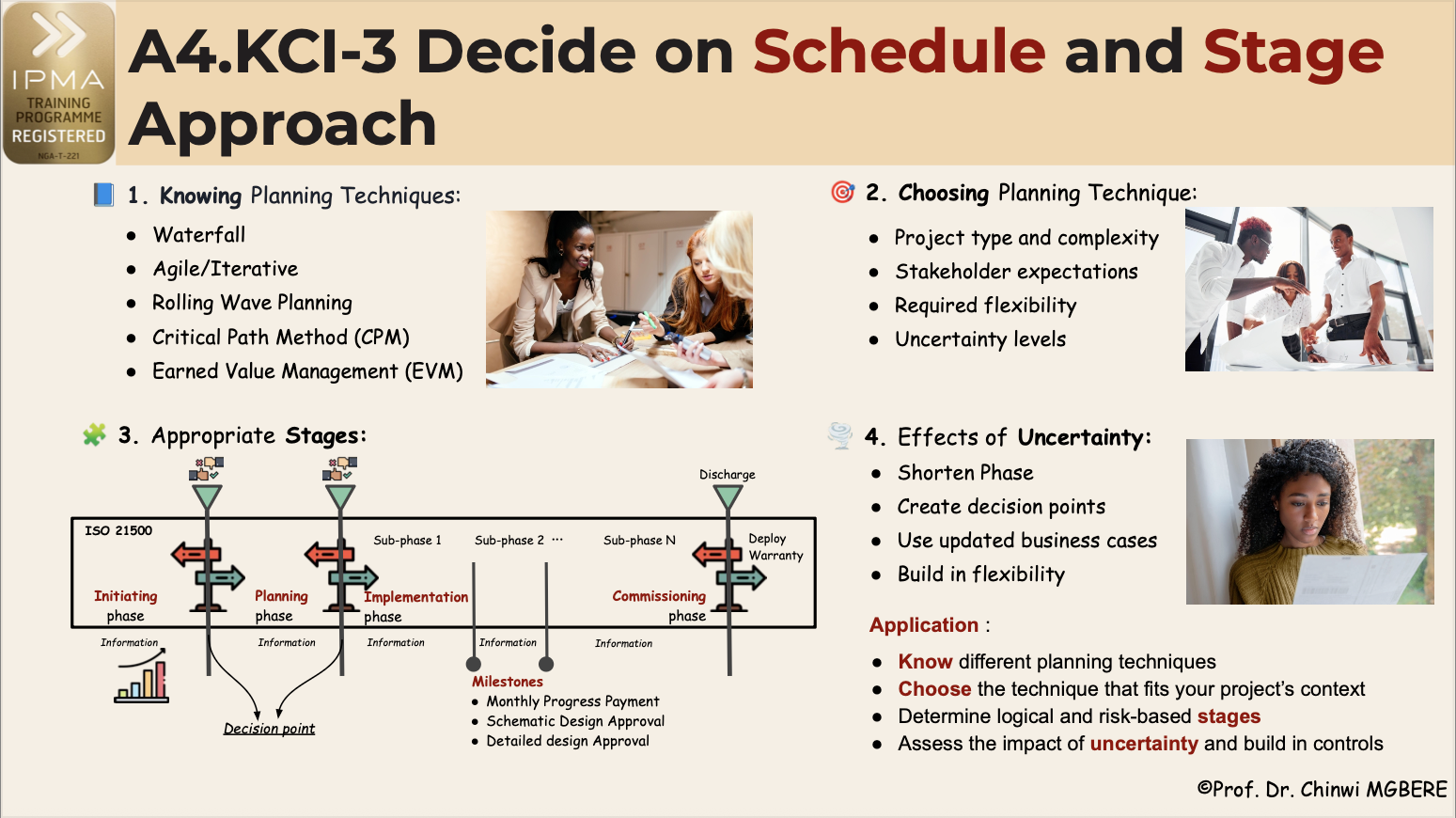
1. Knowing Different Planning Techniques
To make informed decisions, a project manager must understand various planning methods, including:
- Waterfall: Sequential, stage-by-stage approach, best for well-defined and stable projects.
- Agile/Iterative: Flexible, adaptive to change, suitable for projects with evolving requirements.
- Rolling Wave Planning: Planning in waves as the project unfolds, ideal for high-uncertainty environments.
- Critical Path Method (CPM): Identifies key tasks that directly affect the project’s timeline.
- Earned Value Management (EVM): Integrates scope, time, and cost for performance measurement.
Understanding these techniques helps tailor the planning process to the project's size, complexity, and uncertainty level.
2. Choosing the Appropriate Planning Technique
Choosing the right method depends on:
- Project type and complexity
- Stakeholder expectations
- Required flexibility
- Uncertainty levels
For example:
- Use Agile for software development with changing user needs.
- Use Waterfall for construction projects with fixed deliverables and budgets.
Tip: When uncertainty is high, choose planning techniques that allow progressive elaboration.
3. Determining Appropriate Stages
A phase is a manageable portion of the project with a clear decision point. This structure limits risk and enables better control. A basic phased model includes:
- nitiating Phase: Define the business case and high-level schedule.
- Planning Phase: Develop detailed plans and resource estimates.
- Execution Phase: Deliver outputs, monitor progress, and control risks.
- Some projects include a Commissioning Phase to make the end product operational.
Phase terminology could differ slightly. For consistency, use ISO 21500 terms unless your organisation mandates otherwise.
It is necessary to build in a number of decision points at which time sufficient information is available to reassess the project.
Milestones are key events marking the completion of significant tasks or deliverables. They:
- Build team motivation
- Trigger payments
- Improve stakeholder communication
4. Knowing the Effects of Uncertainty (and What to Do About Them)
Uncertainty increases the further you look into the future. To manage this:
- Shorten phases where uncertainty is high
- Create decision points between phases to reassess viability
- Use updated business cases and plans to inform go/no-go decisions
- Build in flexibility through change management and risk mitigation plans
Disadvantages of Phasing
While phases reduce risk, they can also:
- Obscure the big picture
- Result in inaccurate long-term estimates
- Create "fake" decision points when too much has already been invested to stop
To apply these actions to your current initiative, follow these steps:
- Know different planning techniques
- Choose the technique that fits your project’s context
- Determine logical and risk-based stages
- Assess the impact of uncertainty and build in controls
Now, Let’s Test Your Knowledge