- Order the activities into sequence.
- Determine the dependencies.
- Calculate the critical path.
- Process the availability.
2 Hours (CPD)
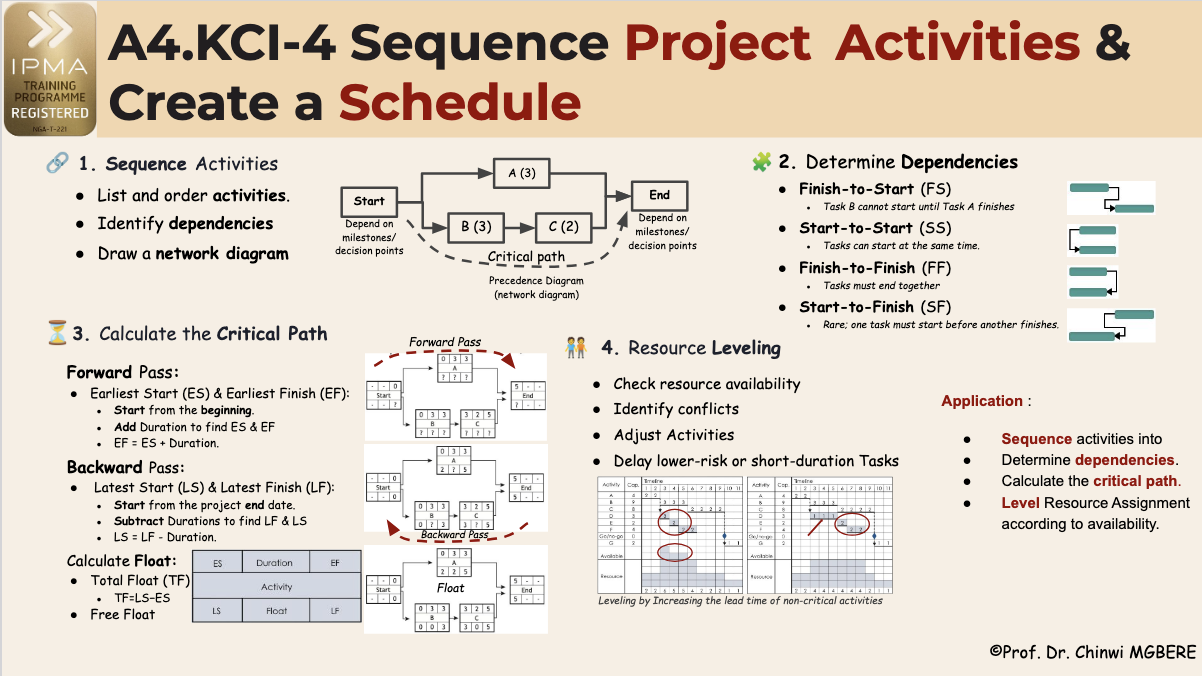
A4.KCI-4. Sequence the activities and plan the duration
Project activities depend on resource availability or the completion of other tasks. By identifying these dependencies and estimating durations, we can build an activity flow and calculate the critical path.
1. Sequence Activities and Identify Dependencies
Every project consists of multiple activities, and their execution must follow a logical flow.
Key Action:
- List and order all project activities.
- Identify dependencies—which tasks must precede or follow others.
Visual Tool: Precedence Diagram
Draw a network diagram (precedence diagram) showing dependencies. This makes it easier to understand the structure of the project and communicate it with your team. For example, two paths lead to project completion:
- Path 1: Activity A (3 weeks)
- Path 2: Activity B (3 weeks) → Activity C (2 weeks)
Total durations:
- Path 1 = 3 weeks
- Path 2 = 5 weeks ← Critical Path
2. Determine Dependencies and Dependent Relationships
Some tasks cannot begin until others are completed. Identifying dependencies ensures that activities are properly aligned.
Types of dependencies:
- Finish-to-Start (FS): Task B cannot start until Task A finishes.
- Start-to-Start (SS): Tasks can start at the same time.
- Finish-to-Finish (FF): Tasks must end together.
- Start-to-Finish (SF): Rare; one task must start before another finishes.
Milestones and Decision Points:
- Milestones are zero-duration activities.
- Plan for time needed to make decisions using lag time or separate tasks.
3. Calculate the Critical Path
The critical path is the sequence of activities that determines the project’s minimum duration. Any delay on this path will delay the project.
Steps to Calculate the Critical Path
- Forward Pass: Calculates Earliest Start (ES) and Earliest Finish (EF):
- Start from the beginning.
- Add each activity's duration to find the Earliest Start (ES) and Earliest Finish (EF): EF = ES + Duration.
- Backward Pass: Calculates Latest Start (LS) and Latest Finish (LF):
- Start from the project’s end date.
- Subtract durations to find the Latest Finish (LF) and Latest Start (LS): LS = LF - Duration.
- Calculate Slack (Float):
- Total Slack: Time an activity can slip without affecting project end.
- Free Slack: Time an activity can slip without delaying subsequent tasks.
Critical Path: Tasks with zero total slack (Float). Delays here impact the overall schedule. For example:
If path A takes 3 weeks and path B–C takes 5 weeks, then B–C is the critical path.
4. Level Resource Assignment (Resource Leveling)
The initial critical path assumes unlimited resources. Schedules must reflect real-world resource constraints. Activities might need to be delayed or reordered based on available staff or equipment.
Resource Levelling Process:
- Check resource availability across the timeline.
- Identify conflicts (e.g., two tasks needing the same person at once).
- Adjust activities not on the critical path first (using slack).
- Delay lower-risk or short-duration tasks, preferably later in the timeline.
Modern scheduling tools like Oracle Primavera Cloud support resource leveling, but relying on your judgment as a planner is key.
To apply these actions to your current initiative, follow these steps:
- Sequence activities by identifying and ordering all tasks logically.
- Determine dependencies by defining how tasks relate to one another.
- Calculate your critical path by identifying the longest sequence with zero slack.
- Level Resources Assignment based on availability by adjusting the plan according to who/what is available.
Now, Let’s Test Your Knowledge