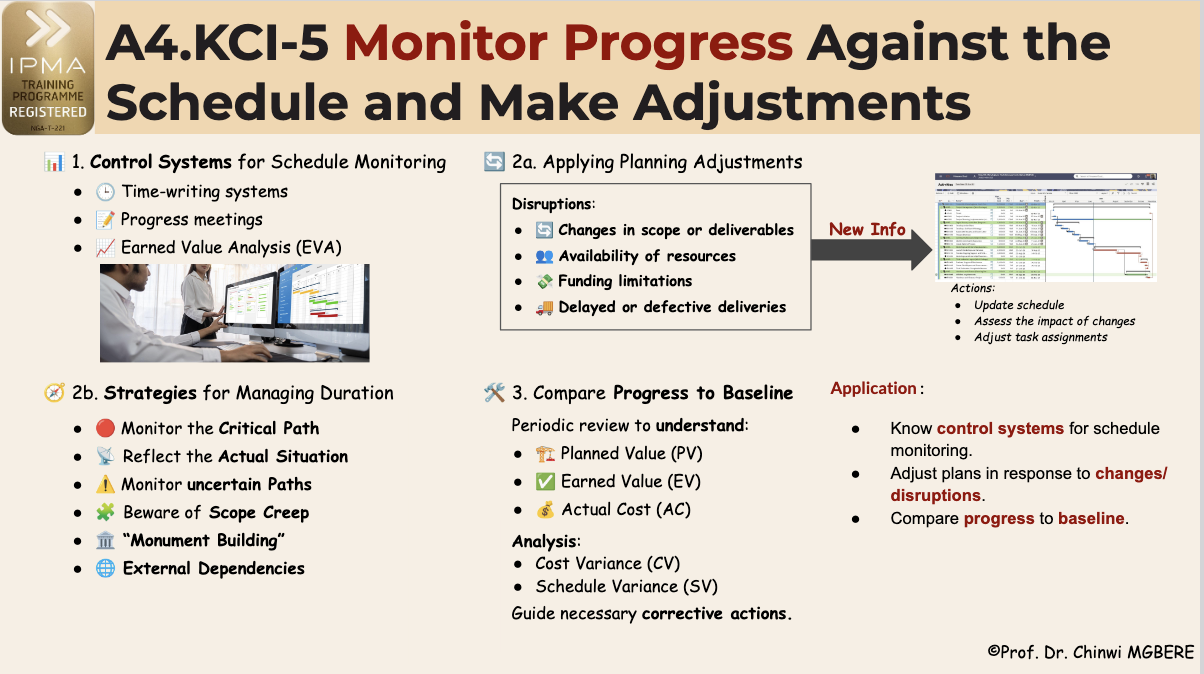
2. Applying Planning Adjustments
Apply planning adjustments in response to various types of disturbances
Projects rarely go exactly as planned. Replanning may become necessary due to a variety of disruptions, such as:
- Changes in scope or deliverables
- Availability of resources
- Funding limitations
- Delayed or defective deliveries
Actions to Take:
- Update your network diagram and schedule with any new data
- Assess the impact of changes on the critical path and float
- Adjust task assignments based on team member experience or skill
2b. Key Considerations for Managing Duration
These practical strategies will help you stay in control of your schedule during execution:
The Critical Path
Monitor the critical path daily. Any delay here directly affects project completion. Track:
- What’s finishing soon
- What’s starting next
- Opportunities to fast-track or compress
Pro tip: Encourage team members to notify you when completing tasks early so that handoffs can be accelerated.
Reflect the Actual Situation
Adjust your schedule with real-time data. Examples:
- More experienced team members may complete tasks faster
- New dependencies or overlooked tasks emerge
- Actual performance differs from original assumptions
Update your schedule and compare it to the baseline to assess impact and decide on course correction.
Uncertain Paths and Risk
Paths with slack today may become critical tomorrow. Conduct path analysis as part of your risk review. Monitor paths with uncertain durations and prepare response strategies.
Beware of Scope Creep
Even minor scope changes can accumulate and disrupt your schedule. Resist the urge to approve small changes without assessing:
- Time
- Cost
- Quality implications
“Monument Building”
When professionals go beyond scope, they may add unnecessary complexity or delay delivery.
Stick to the principle: Deliver what’s agreed—no more, no less.
External Dependencies
Dependencies outside your control should be included as:
- Milestones
- Assumptions
- Risks with mitigation plans
Monitor them separately and have contingency actions ready.
3. Compare Progress to Baseline
Compare progress and earned value against a baseline plan
Periodically review your actual progress against your baseline schedule. Use EVA to understand where your project stands in terms of:
- Planned Value (PV)
- Earned Value (EV)
- Actual Cost (AC)
This analysis provides insight into cost and schedule variances and helps guide informed decisions about necessary corrective actions.
To apply these actions to your current initiative, follow these steps:
- Know When and How to Use Schedule Control Systems. Choose the right tools for progress tracking (e.g., EVM, Gantt charts, daily logs).
- Apply Planning Adjustments When Disturbances Occur. Re-plan when assumptions change or disruptions arise.
- Compare Progress and Earned Value Against the Baseline. Analyze and act on deviations quickly using objective metrics.
Now, Let’s Test Your Knowledge